

National Institutes of Health
The biological clock is located within the suprachiasmatic nucleus in the brain, and is affected by light, as is the pineal gland. Note the near direct pathway along the optic nerve from the eyes to these structures in the brain.
The SCN's circadian alerting signal coordinates a wide array of biological functions that drive our sleep-wake periods, in addition to neurotransmitters. These include thermoregulation -- managing our core body temperature throughout a 24-hour cycle -- and controlling the release of important sleep-wake metabolic hormones like cortisol and melatonin.
The crucial role circadian rhythms, the biological clock, and light have for sleep functioning is confirmed by the experience of those with blindness. Most persons who are completely blind suffer from insomnia to some degree, because they cannot distinguish day from night. With some exceptions, their biological clocks cannot be reset by sunlight or any form of bright light for that matter. Blind persons are sometimes treated with doses of artificial melatonin to help regulate their natural circadian rhythms.
Although the exact function of melatonin in humans is not completely clear, this substance is sometimes prescribed for circadian rhythm disorders and as a “natural” treatment for insomnia, although evidence for its effectiveness in those with normal eyesight is inconclusive.
Melatonin rules the night, cortisol starts the day
The SCN, our master body clock, triggers the production of two key metabolic hormones -- melatonin and its functional opposite, cortisol -- to drive our circadian rhythms and the sleep-wake process.
Cortisol, sometimes called the "stress hormone", tends to have negative connotation because of the connection -- one that is well founded -- to excessive stress and anxiety. Yet, despite the bad rap, cortisol is a beneficial and absolutely essential hormone to normal functioning.
On arising in the morning, cortisol primes the brain and body with reliable energy for waking activity throughout the day. It maintains a stable blood pressure to keep us from fainting. Cortisol regulates the immune system and helps suppress an overresponse to allergens.
More importantly for our purposes, the SCN uses cortisol to pair inversely with melatonin to drive our cycles of sleep and wakefulness.
Journal of Central Nervous System
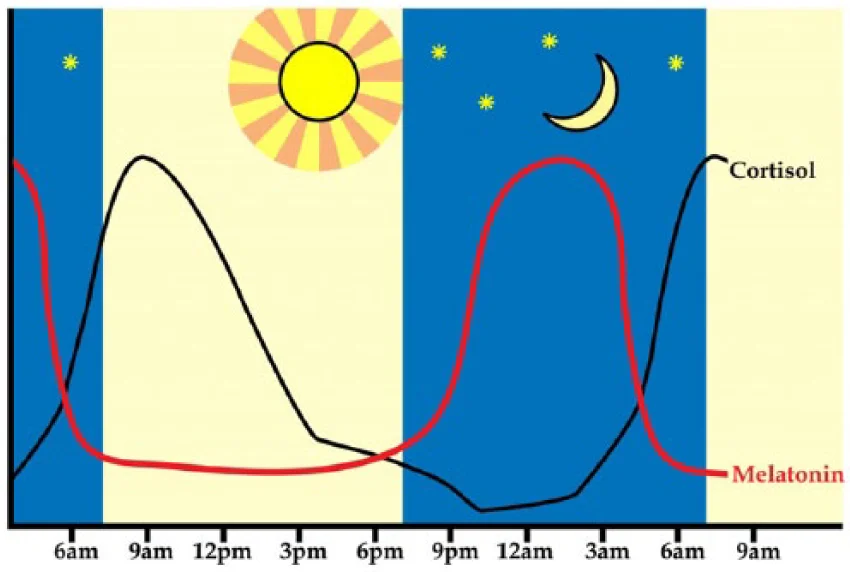
Functional opposites: the release of melatonin and cortisol drive our circadian rhythms
In healthy individuals, melatonin increases with darkness after sunset to help induce normal sleep, then in the middle of the night begins dropping.
Cortisol in tandem with that drop starts increasing several hours prior to awakening, then surges at wake time. The increase in cortisol is what clears away lingering sleep inertia and fully awakens us, usually within about a half hour.
After cortisol's initial surge in the morning, it drops steadily throughout the day. It's normal for cortisol to temporarily increase during waking hours when we might experience stressful events, but in general this hormone trends lower, reaching it's low point during the first half of the night. This is typically when we experience our deepest sleep.
Understanding how our systems use these hormones throughout the day and night helps us better manage sleep. We'll discuss this in depth in the Sleep Hygiene and Controlling Stress sections.
Our biological clocks change as we age
Ideally, our biological clock is synchronized closely to the daily 24-hour cycle of the sun. The reality is not that simple.
One factor is the constantly changing length of day and night throughout the year. Depending on your latitude and the season, there are wide variations in the amount of darkness or sunlight you experience each day, and the duration of daylight typically changes by several minutes for each successive 24-hour cycle. To compensate, our built-in clock constantly adjusts to the changing of the seasons, a process known as entrainment.
Another factor is normal human physiology. From about age 14 to 30, it's common for our biological clock to slow down significantly from a normal 24-hour circadian cycle. Adolescents and young adults may experience more of a 26 to 30 hour day. So for this age group, when 11 p.m. rolls around it may feel more like 7 or 8 p.m. This is why it’s common for a teenager to be wide awake at a normal bedtime. And when it's time to get up at 7 a.m., it may feel more like 3 or 4 in the morning. Hard to get up that early!
Fortunately, by about age 30 most of our biological clocks speed back up to a more normal 24-hour cycle.
Later in life, the biological clocks of some (not all) of us continue to speed up faster than a 24-hour cycle. So this is why 8 p.m. may feel more like 11 p.m. for someone in their 70s , and 4 a.m. may feel more like 7 a.m.
Another possible factor has to do with the gradual aging of the eye. The normal yellowing of the lens and the narrowing of the pupil that occur with age can potentially disturb the body’s circadian rhythm. To help produce better sleep, this condition can be countered by deliberate exposure to indirect sunlight.
Regardless of your age, one way to maintain or recalibrate your biological clock back to normal is to use a consistent wake-up time each day, every day without exception, as much as possible. Then upon awakening immediately expose yourself to light, preferably daylight. This consistency supports better sleep, and we will explain it in much more detail in the Sleep Timing and Sleep Hygiene sections.